Consumer News & Warnings
Best Iron

shopping: How to be the best consumer you can be.
The Pressing QuestionWhich iron works best?
By Tom Bartlett
Posted Tuesday, Oct. 24, 2006, at 7:33 AM ET Ironing is the least popular of all household chores, according to a recent survey consisting solely of me.
But I'm not alone, am I? There must be others who regard ironing with the level of dread usually reserved for root canals or, say, death. Ironing is frustrating, time-consuming, and carries with it the genuine possibility of permanent disfigurement. Say what you want about dusting, but you're unlikely to emerge horribly burned.
I have, on a few occasions, met people who claim to love ironing. They revel in the satisfaction of an extra-crisp collar or well-pressed sleeve. They contend that the very act of ironing, the repetitive back-and-forth motion, is a kind of meditation. While I do my best in life to be nonjudgmental, I am certain these people are crazy, lying, or both.
It is with this unabashedly bad attitude that I tested seven irons to find out which among them was the least objectionable. I tried out the irons on a variety of fabrics—cotton, silk, polyester blends. I used different temperature settings, with and without steam. I ironed until my wrist became tired, my back achy, my soul deadened. I also enlisted the help of an expert with more than four decades of ironing experience who, conveniently, happens to be my mother-in-law.
Methodology
Ease of Use (10 possible points): Is the dial or screen clear and readable? Does it heat up quickly? Can it maneuver easily around buttons and seams? Are the controls intuitive? Because they should be: I do not, under any circumstances, want to consult the manual.
The Feel Factor (10 possible points): Two factors: 1) How does it feel in your hand? 2) How smoothly does it glide across the fabric?
Full Steam Ahead (10 possible points): The flow of steam needs to be reliable and more or less continuous. The "burst of steam" feature that some irons have is also handy, especially for vertical steaming (which is useful for drapes or clothes on a hanger). Also, if the water drips all over when you switch the steam on—sorry, that's a deal-breaker.
ImPRESSive (20 possible points): It's nice, too, if an iron gets rid of wrinkles and creases. In fact, it's the only thing that matters, no? The key here is number of passes. One pass is ideal; two is passable. If I have to run the iron over the same area five or six times, we have a problem.
Here are the results, from rumpled to pressed:
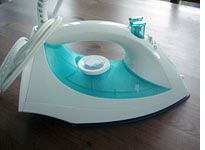 Proctor Silex Mid-Size Iron, $22.50
The first time I tried to fill up the water tank on the Proctor Silex, I spilled water everywhere. This either means I'm an idiot or the water intake is poorly designed. I tried it a second time with similarly damp results, leading me to conclude that poor design is the culprit (the jury remains out on my idiocy).
While the Proctor Silex claims to be capable of vertical steaming, steam did not burst forth in my tests; it was more like a measly puff. Most damningly, the iron does not glide smoothly over a garment. It drags and sticks. Finally, it feels cheap. Happily, at $22.50, it is cheap. That's a point in its favor, but not enough to make it a winner.
Ease of Use: 7
The Feel Factor: 3
Full Steam Ahead: 2
ImPRESSive: 8
Total: 20 (out of 50 possible)
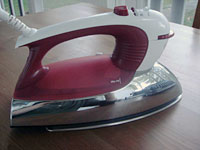 Sunbeam Heritage Steam Iron, $48
The Sunbeam box features a short history of the company that says its mission is "to help moms everywhere." What, us menfolk don't iron? To go with its 1950s sexism, the Sunbeam has a retro, 1950s-inspired design (which I don't like, either). What's more, the Sunbeam is the worst steamer of the bunch. It's perfectly competent at the "burst of steam," but at some temperature settings you get no steam, even with the steam on and the water tank filled.
And—and!—it doesn't get wrinkles out very well. It took several passes to do the job other irons did in one. This is unacceptable. The Sunbeam does have one redeeming feature: It's the only iron I tested that tells you when it has cooled down and is ready to store. A strip on the side turns red when the iron is hot, black when it's cool. This is a great idea and someone who makes a better iron should steal it.
Ease of Use: 6
The Feel Factor: 6
Full Steam Ahead: 3
ImPRESSive: 10
Total: 25
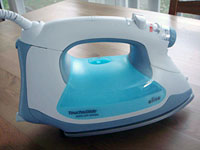 Oliso Touch & Glide Steam Iron, $89.99
I'm torn about Oliso. It is, without a doubt, the niftiest iron on the block thanks to its truly ingenious "auto-lift" system. The iron senses when you let go of the handle and two plastic feet emerge from the soleplate (the part you iron with), lifting it off the fabric. I've shown this to several friends, and it never fails to elicit appreciative "oohs" and "aahs." How many irons can do that?
Also laudable is the thoughtful, easy-to-read temperature dial and the water intake, which is on the side of the iron rather than the front or back, making the iron much easier to fill.
But my Oliso has an almost-fatal flaw. When you turn the steam on, water drips everywhere. A lot of water. I tried this several times to make sure it wasn't a fluke—it wasn't. Also, the Oliso doesn't glide as smoothly as some of the other irons and is bulkier than I would like. If you can cope with the occasional spillage and you want to impress friends/family/dates/passersby with the magical auto-lift system, then pick up the Oliso. If not, don't.
Ease of Use: 8
The Feel Factor: 5
Full Steam Ahead: 5
ImPRESSive: 14
Total: 32
 Reliable Digital Velocity, $129.00
The Reliable has something called a "compact vapor generator" that it claims delivers a steadier stream of steam than other irons. You know what? This seems true. It does not, however, offer the fun "burst of steam" capability. And the digital readout is crude and generally not pleasing. If you're going to slap a fancy screen on there, rather than a plain old dial, at least make it cool.
This thing also feels like an anchor. Maybe you want a heavy iron, maybe you don't. My mother-in-law definitely does not. "No way," was her verdict. "I wouldn't use it on a dare." If continuous steam is your priority, then the Reliable is for you. For the average ironer, I say look elsewhere.
Ease of Use: 5
The Feel Factor: 5
Full Steam Ahead: 8
ImPRESSive: 16
Total: 34
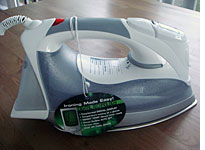 Black & Decker Digital Advantage, $49.99
Black & Decker's tag reads as follows: "Ironing made easier with digital technology."
I think trumpeting its "digital technology" is an attempt to make us think that the primary function of the iron is, in some way, digital—which, of course, it's not. Misleading marketing aside, though, the digital readout is terrific, a hundred times better than the Reliable's. Also, if you need to lower the temperature in the midst of ironing (going from cotton to silk, for instance), the iron will beep and flash "Ready" when the lower temperature has been reached. The burst of steam really bursts, and the iron has an attractive, sleek design. It performed third best but is still awfully good. You could do worse.
Ease of Use: 8
The Feel Factor: 7
Full Steam Ahead: 7
ImPRESSive: 14
Total: 36
 Rowenta Advancer Iron, $129.95
This is the iron that serious ironers—the Ironistas, if you will—breathlessly recommend. "Have you tried a Rowenta?" they cry. "Oh, you simply must!"
I have to admit, it's a top-notch iron. Steamwise, it can't be beat. It has 400 tiny holes in the soleplate; most irons have only 15 or 20. It produces a burst of steam powerful enough to terrify my dog. And its tapered tip makes ironing around buttons a snap. I fully understand why iron snobs love Rowenta.
Like the Reliable, though, the Rowenta is a weighty beast. And the temperature dial is under the handle and therefore hard to access. (Several of the irons put their controls there. Why? Put it on top where I can see it!) Still, I don't think you can go wrong with Rowenta, as long as you don't mind dropping 130 bucks on an iron.
Ease of Use: 5
The Feel Factor: 7
Full Steam Ahead: 10
ImPRESSive: 20
Total: 42
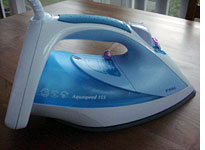 T-Fal Aquaspeed, $69.95
The T-Fal is not without a few T-Flaws. Like the Rowenta, the T-Fal's controls are under the handle and they're not as intuitive and elegant as, for instance, the Oliso or the Black & Decker.
But the T-Fal's water tank can be filled in five seconds. My mother-in-law points out that when doing a lot of ironing, this is a real advantage. And its odd-looking but sturdy base makes it more stable than some of the other irons.
What's absolutely killer about the T-Fal, though, and the reason it's our overall winner, is how it moves over the fabric. The soleplate is coated with enamel and it glides like a dream, better than any of the other irons. Most wrinkles are gone in one pass. When you use it after using a lesser iron, the difference is dramatic.
My mother-in-law's verdict: "Oh, yeah. I love this one."
Love? I don't know. But I certainly like-like the T-Fal. It almost makes ironing kind of, slightly, semi-enjoyable. Almost.
Ease of Use: 6
The Feel Factor: 8
Full Steam Ahead: 9
ImPRESSive: 20
Total: 43
Tom Bartlett is a writer in Mount Rainier, Md. Minor Tweaks is his blog. Join the Fray: our reader discussion forum
What did you think of this article?
Check Out My Other Blogs (click on blog name to go there) = / 1.3rd Eye Blog / 2. Favorites Blog/ 3. Vita Excolatur (Living Well ...) Blog/ 4. Humor Me Blog/ 5. News and Current Events Blog/ 6. Consider This ... Blog/ 7. Consumer Warnings Blog/ 8. New Orleans Pentimento Blog/ 9. We Constant Gardeners Blog/ 10. Chaillot Family Blog/
Ice Cream Scam?
The key thing here is that worrisome sentence: "charging a premium price for ... a mundane product..." Amen.
Slabs Are Joining Scoops in Ice Cream Retailing

Michael Stravato for The New York Times
Customers at a Cold Stone Creamery.
By KATE MURPHY
Published: October 26, 2006
With Baskin-Robbins and Dairy Queen, not to mention thousands of independent scoop shops, there are plenty of places to satisfy a craving for ice cream. But three companies say there is still room for something different — their premium ice creams, served with a flourish.

Michael Stravato for The New York Times
Cold Stone Creamery customers can choose ingredients like crumbled cookies, candies and nuts to be blended into their ice cream.
The three are competing to be to ice cream what Starbucks is to coffee — a ubiquitous chain offering a high-priced, high-quality version of a relatively mundane product.
The companies, Marble Slab Creamery, Cold Stone Creamery and MaggieMoo’s International, sell various flavors of premium ice cream, which is defined by the industry as having more than 12 percent butterfat. Moreover, they allow customers to choose from an assortment of “mix-ins” like crumbled cookies, candies, fruits and nuts. Employees then blend the ingredients into the ice cream on a cold granite or marble slab before packing it into a cup or freshly baked waffle cone. The cost escalates with the number of mix-ins and can easily top $5 for a medium serving.
“These guys are all hoping to be the next Starbucks,” said Donna Barry, a dairy consultant who analyzes the ice cream industry for the market research company Packaged Facts in New York.
Part of the experience is waiting in line and watching employees prepare concoctions. “It’s entertainment,” Ms. Barry said. “I myself get intrigued by what other people order,” like peanut butter ice cream with bananas, marshmallows and brownie chunks.
But in an already crowded market, it remains unclear whether there is a sustainable niche for high-end ice cream, much less one that can support a store on every corner.
Following the Starbucks model, the three chains are densely situating their stores, particularly Cold Stone. Founded in 1988, with its headquarters in Scottsdale, Ariz., Cold Stone has 1,400 franchises in the United States, Japan and South Korea — most opened in the last five years. A former Procter & Gamble sales manager, Douglas A. Ducey, was named chief executive in 2000 to lead the expansion.
“I saw an opportunity to reinvent a stagnant category like what happened with coffee,” he said.
Marble Slab, based in Houston, and MaggieMoo’s of Columbia, Md., have also pursued rapid growth strategies in the last five years. Marble Slab, which opened its first store in 1983, now has 371 franchises in the United States, Canada and the United Arab Emirates, with another 220 under development. Started in 1989, MaggieMoo’s currently has 190 franchises in the United States with an additional 150 under development.
“These guys are definitely trying to saturate the market,” said Darren Tristano, managing director of Technomic, a food service research and consulting firm in Chicago. “It’s all a game of beating the other guy to the best locations.”
Americans spend about $21 billion a year on ice cream, according to the International Dairy Foods Association. That amounts to 1.6 billion gallons of ice cream, or 21.5 quarts a person a year. Almost two-thirds of that ice cream is eaten away from home.
“It’s not a small category,” said Harry Balzar, president of the NPD Group, a market research company in Port Washington, N.Y., but one that has remained flat for more than a decade and is “not likely to grow.”
To succeed, Cold Stone, Marble Slab and MaggieMoo’s need to take customers from the market leaders Dairy Queen and Baskin-Robbins and the more than 15,000 other independent and chain ice cream shops scattered across the country. This includes Ben & Jerry’s and Häagen-Dazs, which are steadily adding locations, though their focus is more on grocery store sales.
“The Cold Stones and the like have to take business from competitors or increase the frequency of customer visits,” Mr. Balzar said.
Demand was arguably high as several people waited in line on a recent weekday afternoon at a Marble Slab Creamery in Houston. “I was on my way home from jury duty and figured I’d use the $6 they paid me to buy an ice cream,” said Lee Beauchamp, a petroleum marketer, who was enjoying a double dip of dark chocolate coconut and birthday-cake-flavor ice cream.
But Howard Waxman, editor of The Ice Cream Reporter, an industry newsletter, questioned how much of an appetite there is for expensive customized ice cream. “People often have very personal or psychological associations with ice cream,” Mr. Waxman said. “They’ll try something new but they tend to go back to the kind of ice cream they grew up eating.”
That is the way it was for Tony Green, a management consultant in Chicago, who tried Cold Stone and Marble Slab once or twice because he said his two children “are all about mixing as much candy into their ice cream as possible.” Even so, the family favorite is still an independent, old-fashioned ice cream parlor called Margie’s Candies that they have gone to for years. “It’s a throw-back nostalgia kind of place,” Mr. Green said.
Such loyalties and perhaps market saturation might explain why sales at Cold Stone stores open for more than a year were down for the first time last year, by 6.6 percent, and are down 7 percent so far this year. Including revenue from newly opened stores, the company expects sales to reach $465 million this year, up 46 percent from last year. Mindful of the decline in sales at existing stores, Mr. Ducey said Cold Stone would slow its expansion. “We first wanted to secure premier locations and build awareness and now we are going to focus on the amount of product sold,” he said.
Marble Slab, which has pursued a more measured growth strategy, estimates this year’s sales will be $90 million, up from $75 million last year, with sales at stores open for more than a year increasing 3 percent.
“Our primary focus has always been on trying to offer the highest-quality product — we only open new stores when it makes sense,” said Ronald Hankamer, Marble Slab’s president and chief executive.
MaggieMoo’s projects $50 million in sales this year, up from $43 million last year. The company would not release sales at stores open for more than a year. It has dropped to 416 from 169 in 2004 on Entrepreneur Magazine’s ranking of the top 500 franchise opportunities. Cold Stone and Marble Slab have climbed in the 2006 rankings, to 24 and 297, respectively. MaggieMoo’s closed six underperforming stores in Bangkok this year and canceled plans for further overseas expansion.
Still, the three chains are hardly hurting for franchisees. Cold Stone, for example, received 25,000 applications last year.
“A lot of people want to get into the business because it sounds like fun,” said Mr. Waxman of The Ice Cream Reporter. And it is relatively inexpensive to buy in, with $200,000 to $450,000 in upfront costs and fees plus 6 percent royalties on sales. By contrast, purchasing a McDonald’s franchise requires a $506,000 to $1.6 million initial investment plus a minimum of 12.5 percent royalties on sales.
The majority of franchisees at Cold Stone, Marble Slab and MaggieMoo’s own more than one location and as many as 11. “It’s how you create economies of scale so you can increase your margins,” said Rudy Puig, who owns three Cold Stone stores in Miami, and plans to buy another next year.
But he said the real reason he was in the ice cream business is “my kids used to cry if we didn’t stop for ice cream.” Now that is not a problem.
Check Out My Other Blogs (click on blog name to go there) = / 1.3rd Eye Blog / 2. Favorites Blog/ 3. Vita Excolatur (Living Well ...) Blog/ 4. Humor Me Blog/ 5. News and Current Events Blog/ 6. Consider This ... Blog/ 7. Consumer Warnings Blog/ 8. New Orleans Pentimento Blog/ 9. We Constant Gardeners Blog/ 10. Chaillot Family Blog/
Drug Reactions
Study Finds a Widespread Risk of Reactions to Some Medicines
By THE ASSOCIATED PRESS
Published: October 18, 2006
CHICAGO, Oct. 17 (AP) — Harmful reactions to medicines, usually attributed to accidental overdoses and allergic reactions, send more than 700,000 Americans to emergency rooms each year, government research shows.
People over 65 faced the greatest risks.
The results, from 2004-5, represent the first two years of data from a national surveillance project on outpatient drug safety. The project was developed by the federal Centers for Disease Control and Prevention, the Food and Drug Administration and the United States Consumer Product Safety Commission.
The study is to be published Wednesday in the Journal of the American Medical Association.
“This is an important study because it reinforces the really substantial risks that there are in everyday use of drugs,” said Bruce Lambert, a professor at the college of pharmacy at the University of Illinois, Chicago.
The study’s authors and other experts agreed that 700,000 was probably a low estimate because bad drug reactions were likely to be misdiagnosed.
The medicines most commonly implicated in the reactions included insulin for diabetes; warfarin, an anticoagulant, and amoxicillin, an antibiotic used for many infections.
“These are old drugs which are known to be extremely effective,” said Professor Lambert, who was not involved in the research. “We could not and would not want to live without them. But you’ve got to get the dose exactly right. Variations, especially on the high side, are really dangerous.”
People 65 and older faced more than double the risk of requiring emergency room treatment and were nearly seven times more likely to be admitted to the hospital than younger patients.
The study’s database included 63 nationally representative hospitals that reported 21,298 bad drug reactions among adults and children treated in emergency rooms during the two-year period.
The tally is based on what emergency room doctors said were complications from using prescription drugs, over-the-counter medicines, dietary supplements or herbal treatments. The researchers said it translated to 701,547 complications nationwide each year.
“Experts had thought that severe outpatient drug events were common, but no one really had good numbers” until now, said the study’s main author, Dr. Daniel Budnitz.
Check Out My Other Blogs (click on blog name to go there) = / 1.3rd Eye Blog / 2. Favorites Blog/ 3. Vita Excolatur (Living Well ...) Blog/ 4. Humor Me Blog/ 5. News and Current Events Blog/ 6. Consider This ... Blog/ 7. Consumer Warnings Blog/ 8. New Orleans Pentimento Blog/ 9. We Constant Gardeners Blog/ 10. Chaillot Family Blog/
Microwave danger or NOT?
Really?
The Claim: Microwave Ovens Kill Nutrients in Food
By ANAHAD O’CONNOR
Published: October 17, 2006
THE FACTS They are a staple in kitchens everywhere, but for about as long as microwave ovens have been around, people have suspected that the radiation they emit can destroy nutrients in food and vegetables.
According to most studies, however, the reality is quite the opposite. Every cooking method can destroy vitamins and other nutrients in food. The factors that determine the extent are how long the food is cooked, how much liquid is used and the cooking temperature.
Since microwave ovens often use less heat than conventional methods and involve shorter cooking times, they generally have the least destructive effects. The most heat-sensitive nutrients are water-soluble vitamins, like folic acid and vitamins B and C, which are common in vegetables.
In studies at Cornell University, scientists looked at the effects of cooking on water-soluble vitamins in vegetables and found that spinach retained nearly all its folate when cooked in a microwave, but lost about 77 percent when cooked on a stove. They also found that bacon cooked by microwave has significantly lower levels of cancer-causing nitrosamines than conventionally cooked bacon.
When it comes to vegetables, adding water can greatly accelerate the loss of nutrients. One study published in The Journal of the Science of Food and Agriculture in 2003 found that broccoli cooked by microwave — and immersed in water — loses about 74 percent to 97 percent of its antioxidants. When steamed or cooked without water, the broccoli retained most of its nutrients.
THE BOTTOM LINE Microwave ovens generally do not destroy nutrients in food.
scitimes@nytimes.com
Check Out My Other Blogs (click on blog name to go there) = / 1.3rd Eye Blog / 2. Favorites Blog/ 3. Vita Excolatur (Living Well ...) Blog/ 4. Humor Me Blog/ 5. News and Current Events Blog/ 6. Consider This ... Blog/ 7. Consumer Warnings Blog/ 8. New Orleans Pentimento Blog/ 9. We Constant Gardeners Blog/ 10. Chaillot Family Blog/
Medical Procedures Overseas
Spending
Basking on the Beach, or Maybe on the Operating Table

PlanetHospital
Radiologists at the Max Hospital in New Delhi review cardiac data. Uninsured Americans can have surgery in India at a fraction of the cost they would face at home.
By JENNIFER ALSEVER
Published: October 15, 2006
SO you have a bad hip that needs surgery, but you don’t have health insurance. What to do? Go on vacation.
Skip to next paragraph 
Phillippe Diederich for The New York Times
Gary Hulmes, who manages a furniture store in Englewood, Fla., had spinal surgery in India. He paid $9,000 for the three-week trip, which also included sightseeing.
A growing number of Americans are taking that path, traveling to countries like Thailand, Costa Rica and Malaysia for cosmetic, orthopedic and heart surgeries and other medical and dental treatments that cost 20 to 80 percent less than at home.
The number of these travelers varies, depending on whom you ask, but there is no doubt that health travel is growing, hastened by the fact that 46 million Americans are uninsured and that health insurance costs are soaring.
In Bangkok, Bumrungrad International Hospital counts 55,000 American patients a year. It describes itself online to visitors much the way a hotel would, with photographs of rooms, lists of surgery prices and amenities for patients, like laptop computer rentals and secretarial services.
In Costa Rica, construction is under way on new medical retreats — basically hotels with nurses and medical amenities to help patients recuperate from surgery. In India, hospitals are sprouting that offer foreigners fine dining, marble bathrooms and manicured lawns. The hospitals promote the fact that they have credentialed physicians and a one-to-one ratio of nurses and patients.
Yet going overseas for medical care is not without risks. Life-threatening complications, possible with any surgery anywhere, can arise far from home, and medical travel brochures don’t always adequately inform consumers of standards for hospitals, medical providers and post-operative care.
“It’s so hard to judge the quality overseas,” said Dr. Kenneth Ouriel, chief of surgery at the Cleveland Clinic. “The reporting standards are different. The language is different. It’s hard enough in the U.S.”
Still, medical tourism has spawned a cottage industry of travel agencies willing to book hotels and air travel, find doctors and arrange surgeries. Often, they provide concierges who pick up patients at the airport, provide them with cellphones and wait with them at the hospital, consulting with doctors and keeping relatives apprised.
“Safety is the big thing,” said Stephanie Sulger, president of Medical Tours International, in Cold Spring, N.Y., which has turned down patients who weren’t healthy enough to travel.
Medical Tours International has 12 registered nurses and three doctors who help patients plan medical treatment and trips. They also visit and check out the overseas hospitals — noting, for example, whether they have emergency evacuation signs in English — and evaluate doctors, requesting copies of their credentials, talking with doctors’ colleagues and reading what patients say about them on online message boards.
Last year, Medical Tour International sent 1,324 people to India, Costa Rica, Thailand and Brazil for procedures like in-vitro fertilization, dental work and orthopedic surgery. Ms. Sulger says she expects sales this year to reach $1 million.
In April, Gary Hulmes, a furniture store manager in Englewood, Fla., paid $295 to a company called PlanetHospital, based in Calabasas, Calif., to help him plan a trip to India. In back pain for months and without health insurance, Mr. Hulmes, 44, opted to go to a Max Hospital in New Delhi for spinal surgery rather than having it done at home.
He paid $9,000 for the three-week trip, which included a five-day hospital stay, airfare, hotel and sightseeing at spots like the Taj Mahal. At home, it could have run $36,000 to $50,000, according to the American Academy of Orthopaedic Surgeons.
American hospitals “offered me a payment plan, but I would have been in debt for the next 10 years,” said Mr. Hulmes, adding that his recovery is going well. “When you’re uninsured and you don’t have a whole lot of options, it’s pretty scary.”
Credit the lower costs to factors like lower salaries and training costs and fewer malpractice lawsuits abroad, said Josef Woodman, author of “Patients Without Borders: The Smart Traveler’s Guide to Getting High-Quality Affordable Healthcare Abroad,” which will be published in February 2007 by a new imprint, Health Travel Communications, in Chapel Hill, N.C.
Mr. Woodman traveled to Costa Rica for dental work last spring. The treatment and trip cost $2,100, instead of the $4,100 it would have cost back home.
GlobalChoice Healthcare, in Albuquerque, offers patients a menu of comparative prices. A coronary artery bypass, it said, could cost $75,536 in the United States but $11,438 in India; a $36,664 knee replacement here might be $17,824 in Singapore.
Such savings have caught the attention of large and small companies, too. United Group Programs, an insurer in Boca Raton, Fla., offers medical travel in its health plans to 4,300 corporate clients. About 40 employers now offer those plans to employees.
The West Virginia legislature is studying a proposal that would encourage state employees to travel abroad for some procedures, giving them cash bonuses equivalent to 20 percent of the net cost savings. The balance of the savings would go into a fund to reduce the amount employees pay for health care premiums. State Delegate Ray Canterbury, a Republican who proposed the bill, said he thinks such a shift could add to pressure to make domestic health care more affordable.
In Britain, the government has authorized patients to go overseas for medical treatment in certain cases.
Among the factors that may help put some Americans at ease are the numerous American-trained doctors abroad and a rising number of foreign hospitals certified by the Joint Commission International, the international arm of the United States-based Joint Commission on Accreditation of Healthcare Organizations, which reviews 18,000 domestic hospitals.
The international commission ensures that hospitals have translators, qualified doctors and nurses and are up to American standards for safety and cleanliness. It has accredited 100 foreign hospitals since its start six years ago. With medical tourism dollars in mind, more hospital executives in Asia and Central America are seeking its stamp of approval, said Maureen Potter, its executive director for accreditation.
Accreditation, however, does not guarantee a good outcome. And foreign hospitals are not bound by the same regulations as hospitals in the United States, and consumers may not have the same rights to litigation if something goes wrong.
If complications arise, a hospital may have a specialist for a particular surgery, but it may lack other specialists like an infectious-disease doctor, who would be important to a patient if there were complications, said Dr. Irving L. Kron, a cardiac surgeon and secretary of the American Association for Thoracic Surgery.
People who are considering medical travel should ask many questions, experts say. For example, they can check whether the hospital is accredited, whether the doctor is adequately certified and whether he or she speaks comprehensible English. And they can talk to former patients and research doctors who have American board certification on HealthGrades.com.
Mr. Woodman also suggests bringing along a companion who can fetch prescriptions and consult with the doctor. Patients should also warn their banks before traveling, so their credit cards aren’t rejected.
PlanetHospital, which helped Mr. Hulmes with his trip, caters to nervous patients with a service called “the best of both worlds,” in which American doctors travel with patients overseas to perform surgeries and then handle follow-up care back home.
PlanetHospital’s price for a heart valve replacement in India with an American doctor is $11,000. That includes the doctor’s malpractice insurance as well as airfare and hotel for both physician and patient. The surgery typically costs about $55,000 in the United States. PlanetHospital now offers it to insurers, which can offer it to employees.
The first patient has signed up for the service, and PlanetHospital’s owner, Rudy Rupak, expects more to do so soon. “I can give you a familiar doctor and suddenly it makes it affordable,” Mr. Rupak said. “Your geography changes but everything else stays the same.”
Check Out My Other Blogs (click on blog name to go there) = / 3rd Eye Blog / Favorites Blog/ Vita Excolatur (Living Well ...) Blog/ Humor Me Blog/ News and Current Events Blog/ Consider This ... Blog/ Consumer Warnings Blog/ New Orleans Pentimento Blog/ We Constant Gardeners Blog/ Chaillot Family Blog/
Psychoanalysis questioned
A Conversation With Dr. Owen Renik
An Analyst Questions the Self-Perpetuating Side of Therapy
Published: October 10, 2006
As a young boy growing up in the Bronx, Owen Renik saw his mother struggle with depression, watched helplessly as she deteriorated from a muscle-wasting disease, and spent months living with relatives because she was unable to care for him. From that powerlessness grew a desire to become a doctor. By the time Dr. Renik was out of college and had worked for a time driving a taxi in New York — an immersion course in brief counseling while dodging traffic — it was clear what kind of doctor he would be.

Darcy Padilla for The New York Times
Dr. Owen Renik has written a manual that includes tips on when to end treatment.
He fell hard for Freud, and as a successful psychoanalyst who was also a prolific writer and engaging speaker, he rose quickly in the psychoanalytic establishment. He has held high office in the American Psychoanalytic Association and at the field’s premier journal, The Psychoanalytic Quarterly, where he served as editor in chief for about a decade. As an insider, he has questioned the techniques and affectations of analysis in an attempt, he says, to spare the science of psychoanalysis from those who would make it a monastic ritual, a priesthood.
His book “Practical Psychoanalysis for Therapists and Patients,” released last month, is meant to give therapists, their clients and anyone interested in therapy a sense of how to navigate the chutes and ladders of treatment, what to expect from therapy and how to know when it’s time to stop. Dr. Renik, 64, has a private practice in San Francisco and is a training and supervising analyst at the San Francisco Psychoanalytic Institute and Society.
Q. Why do you think the profession of psychoanalysis needs corrective advice now?
A. The profession is in a great decline, and I predict the decline will continue. The reason for it, and the reason a corrective is needed now, is that although psychoanalysis began in a spirit of open-ended inquiry, with an orientation above all to be helpful to the patient, it took on a self-perpetuating guild mentality that was its ruin. The possibility is still open to reverse the decline, but it will be necessary to escape the clutches of an establishment that, unhappily, has increasingly gotten away from the original scientific enterprise.
Q. You place great emphasis in the book on symptom relief as the central measure of the effectiveness of therapy. Shouldn’t that be obvious?
A. Not necessarily. There is a tendency among psychoanalysts to pursue self-awareness as a goal in itself, rather than a means to an end. Originally, the idea was that the self-understanding that arose as a result of psychoanalysis was unique and impressive and valid because it afforded relief from symptoms that were otherwise impossible to treat.
If you don’t require that self-awareness be validated by symptom relief, there are two destructive consequences. The first is scientific. You have no independent variable to track; you set up a circular situation in which it’s the analyst’s theory that determines what is found in analysis. Many critics of psychoanalysis have recognized this.
But an equally important consequence is that you relieve the analyst of any accountability. The process can go on forever, and there are all kinds of temptations to extend it, including the therapist’s vanity, his inability to admit failure, his narcissism — and nobody likes lost income. The therapy then becomes an esoteric practice of proselytizing, rather than a discipline, and the proof of that is everywhere in the world, where fewer and fewer people go to analysis at all. If the therapy worked, people would be going.
Q. How long should you have to wait before expecting to see positive changes in your life?
A. I have no precise and general answer, but there should be evidence very quickly of some progress. This idea that you have to wait around a long time for the fruit to drop from the tree is nonsense. If you don’t see progress soon, you should move on. If you don’t get better quickly with the next person, fine; you may conclude that the process will take a little longer than you expected. But nothing all that much is lost. Hanging around forever and ever with the same person has a much greater nonrefundable cost.
Q. You challenge the traditional analytic notion that the therapist should be a neutral guide. Why?
A. I think there is a tendency to confuse a nonjudgmental attitude with the psychoanalytic concept of neutrality. But none of us can help having a personal take on any issue a patient is discussing, and there is no way for us to think about any issue — let alone intervene — without that being influenced by our own very personal psychology.
Therefore, the only thing that happens when we aspire to relative neutrality is that we encourage the analyst and the patient to create a fiction of impersonal contribution. That makes the influence of the analyst’s personal assumptions all the more powerful, because they’re exempted from review, they go underground.
Q. Doesn’t psychoanalysis find that some patients deliberately sabotage themselves because, consciously or not, they don’t really want to get better?
A. Yes, and this is a species of patient blaming. It means the analyst hasn’t understood what the patient’s misguided motivations are. Everybody is trying to cut himself the best deal possible, and if it looks like somebody is trying to do himself in, it’s only because he is trying to escape greater harm by doing so. One example from the book was rather ironic: the patient was continually attacking me, verbally, knowing that his accusations would be discredited. This preserved his wishful thinking that nothing was as it seemed and that his mother was more loving and supportive than he experienced her as being. Discovering this proved to be a turning point in the therapy.
Q. If psychoanalysis is to be more practical in the ways you suggest — providing quick symptom relief, discarding the fiction of therapist neutrality, encouraging more patient collaboration in treatment — is it still psychoanalysis?
A. Yes, I think it is. There are any number of traditional concepts that remain very useful, perhaps the most familiar being unconscious motivation. The effort to reveal such motives when they’re important remains. Another principle unique to psychoanalysis is paying close attention to the treatment relationship itself, and its role in the cure.
But the point is that technique should never define a science. Psychoanalysis doesn’t mean lying on a couch, it doesn’t mean coming in five times a week, and it doesn’t even mean free association. It means applying concepts scientifically to better understand patients.
Q. When is it time to stop therapy?
A. You should have a criterion for judging whether the outcome is satisfactory, which leaves you free to judge by trial and error. If the treatment seems sufficient, you stop. You can always resume the therapy when and if there’s a need. What might also happen along the way, you might become aware of other things that then you define as symptoms, and you want to address those. Let’s say you have trouble dating, for example. We discover when we look into it that you have trouble asserting yourself, and that applies in a number of areas, including your work life. So we go on, until you are able to make progress there. If you’re not having symptom trouble after that, there’s no reason to keep analyzing stuff. That’s it. You’re done.
Check Out My Other Blogs (click on blog name to go there) = / 3rd Eye Blog / Favorites Blog/ Vita Excolatur (Living Well ...) Blog/ Humor Me Blog/ News and Current Events Blog/ Consider This ... Blog/ Consumer Warnings Blog/ New Orleans Pentimento Blog/ We Constant Gardeners Blog/ Chaillot Family Blog/
Hunting in a Park Preserve?
Santa Rosa Island Journal
A Multipronged Tussle Over the Fate of Herds Living in an Island Park

Axel Koester for The New York Times
The 1,150 deer and elk on Santa Rosa Island, like the Kaibab deer, are said to compromise the native ecosystem.
Published: October 9, 2006
SANTA ROSA ISLAND, Calif., Oct. 3 — There are hunters who dream about places like this.

Axel Koester for The New York Times
Tim Vail, right, with his cousins Will Woolley and Nita Vail, whose family used to own the island.
The game — unusually large Kaibab deer, Roosevelt elk that lope like thoroughbreds along the wind-scoured ridgelines — are trophy quality. All it takes to bag one is a 30-mile trip across the Santa Barbara Channel, a rifle, good aim, a minimum fee of about $8,000 and the existing agreement by the National Park Service to close 45,000 acres of parkland to the public, August through December.
Close a public park to make way for a private hunt? That is not the Park Service’s preference. When it acquired Santa Rosa Island at the time the Channel Islands National Park was formed in 1986, it accepted a 25-year transition period during which the hunting would continue. It wants the animals off the island. The 1,150 deer and elk, park officials say, compromise the native ecosystem — by munching on seedlings of the rare island oaks, for instance.
An advocacy group, the National Parks Conservation Association, is also arguing against continuing to open parkland to private pursuits. Its late 1990’s lawsuit ensured that the herd’s 100-year history on the island would end. Starting in 2008, the herd was to be whittled down, either shipped out or shot. By 2011, it would be gone.
That was the deal until Representative Duncan Hunter came along. A powerful Congressional committee chairman who seems named, if not born, for this dispute, Mr. Hunter, Republican of California, believes the island’s hunt must go on. But the Interior Department is not in his purview. The Defense Department is.
First, Mr. Hunter, the chairman of the House Armed Services Committee, suggested that military personnel and their guests should enjoy the hunt. Then he said it should continue for disabled veterans.
Neither of these proposals went over. But last week the huge military authorization bill emerged from a House-Senate conference committee with a vestige of the chairman’s original proposal, as inscrutable as the Cheshire cat’s smile. No disabled veterans were mentioned. Not even the word “hunt.”
But by forbidding the park service to “exterminate or nearly exterminate” the animals, Mr. Hunter ensured that, unless someone shipped them out, the deer and elk would remain.
At whose expense? Presumably the Park Service’s, since the families that sold the island ranch to the government will have no more presence here after the transition period ends in 2011.
For whose benefit? That remains unclear. Mr. Hunter’s office is circulating an approving letter from a three-year-old Nebraska group called the Wounded Warriors Project. (A more established group, the Paralyzed Veterans of America, declined after their representative reported that the island’s steep hills and angular drainages were not wheelchair accessible.)
What is clear is who is pleased with the turn of events: largely the descendants of the Vail family, who are heirs to the assets of the Vail & Vickers ranching company, which sold the land to the Park Service. Tim Vail, one of three cousins who played host to a gathering of California ranchers on the island last week, said, “We would not like to see the slaughter of those animals.”
Asked to describe the difference between the Park Service’s elimination of the herd and the private hunting, which benefits his family, Mr. Vail said: “Slaughter is removing all the animals. Hunting is maintaining their health as a herd.”
It is also clear who is deeply disappointed: the Park Service, the conservation association and Representative Lois Capps, a Democrat who represents Santa Barbara and Channel Islands National Park. For them, preserving the park means restoring the landscape that existed before sheep, cattle, deer and elk were introduced.
“Now, nonnative species have priority over native species that are going to go extinct,” said Russell Gallipeau, the park’s superintendent.
Yvonne Menard, the park’s chief of interpretation, argues that the park’s mission is to restore the island’s original landscape. Ms. Menard recounts with zest the news that, for the first time in decades, a bald eagle hatched on Santa Rosa. Moments later, she bends down sadly over a well-nibbled island oak shoot.
The bones of a pygmy mammoth and Arlington Man — at 13,000 years the oldest human skeleton found in North America — are part of the island’s history. The ranching and hunting legacy of the past 170 years is also uniquely valuable, she said, but not as current practice.
Under the new legislation, managing the deer and elk may well be part of the Park Service’s job in five years. Practically, Mr. Gallipeau said, that means managing a hunt or paying the considerable costs of shipborne removal and taking on the burden of managing the skittish animals on the sometimes rough two-hour channel crossing.
The simplest management technique, shooting the animals en masse from helicopters, is forbidden by Mr. Hunter’s legislation. The only simple alternative is some kind of traditional hunt — maybe something like the hunt now run by Vail & Vickers, although the Park Service has no budget for such activity.
Mr. Hunter said in an interview that, given that only 30,000 people a year visit any of the five islands in the park, accommodating some disabled veterans and their families a few weeks a year was not unreasonable. “We did this as a first step,” he said.
Then, he said, he wants the Wounded Warriors group to put together a plan of use to suit their members. “You’ve got my commitment: I will never hunt there,” Mr. Hunter said. “I only want disabled people who served their country in war. That won’t ruin the day of these environmentalists whose freedom is guaranteed by their service.”
The herds, he said, could be managed by the game management personnel at nearby mainland military bases.
Ms. Capps, who debated sharply with Mr. Hunter on the House floor the day the military authorization bill passed, said the chairman was showing “the arrogance of power” by including an amendment that could not be voted on in its own right.
“This is about what the park means to this country in terms of its values,” she said, adding, “What if there were a hunting operation like this in Yosemite? The Grand Canyon?”
In the next Congress, Ms. Capps said, she plans to introduce legislation to undo Mr. Hunter’s, assuming, as all parties do, that the Senate will follow the House and approve the military authorization bill when Congress reconvenes after the November election. Likewise, Mr. Hunter plans a follow-up to his bill.
The Vail descendants — the first cousins Tim Vail, Nita Vail and Will Woolley — say they believe that the Park Service goal of returning the island to its natural state is hopelessly utopian.
“They’re trying to get it back to a period that never existed,” Mr. Woolley said. Nita Vail added, “The reality is, any kind of ecosystem evolves.”
Check Out My Other Blogs (click on blog name to go there) = / 3rd Eye Blog / Favorites Blog/ Vita Excolatur (Living Well ...) Blog/ Humor Me Blog/ News and Current Events Blog/ Consider This ... Blog/ Consumer Warnings Blog/ New Orleans Pentimento Blog/ We Constant Gardeners Blog/ Chaillot Family Blog/
Milk - Organic
Which Cows Do You Trust?

Kevin P. Casey for The New York Times
Wilcox, south of Tacoma, Wash., has eliminated milk from hormone-treated cows.
Published: October 7, 2006
MONROE, Wash. — For demanding consumers, some dairy producers are demanding less milk from their cows — and charging more for it.

Kevin P. Casey for The New York Times
Cleaning up at Jim Werkhoven’s farm in Monroe.

Kevin P. Casey for The New York Times
Jim Werkhoven says he is not convinced that consumers are really clamoring for milk from untreated cows.

Photographs by Kevin P. Casey for The New York Times
Monsanto calls its artificial growth hormone for cows Posilac. The company does not release sales figures.
The dairy companies are bowing to the natural-foods trend by shunning milk from cows treated with genetically engineered growth hormone.
By labeling milk free of the artificial hormone, the dairy industry can ride the popularity of natural foods, without the greater expense and special feeds required to produce milk that can be fully certified as “organic.”
As a result hormone-free milk can be priced higher than conventionally labeled milk, but less than organic.
At a Safeway near central Seattle, for example, a half gallon of conventional Lucerne-brand whole milk was recently selling for $1.69, while the Horizon organic brand was priced at $3.69.
Priced neatly in between, at $2.79, was the Darigold milk labeled as “coming from cows not treated with the growth hormone rBST*”
The asterisk referred to tiny letters near the bottom of the carton indicating that the Food and Drug Administration says there is no difference between milk from treated and untreated cows.
Some milk producers have long avoided the hormone rBST, which is made by Monsanto and was approved by the F.D.A. in 1993. Still, it has been in wide enough use since then, as a way to increase a cow’s milk supply by a gallon or more a day, that many of the nation’s dairy products probably contain milk from cows injected with the hormone.
Many pure-food advocates oppose the hormone’s use on health grounds, saying it can require cows to be treated with extra antibiotics and can result in milk with higher amounts of a separate hormone linked to cancer in some studies. But only recently do more consumers appear to be paying heed to those concerns, as part of the growing interest in whole and natural foods.
Experts say that avoiding the hormone is the main reason people buy organic milk, whose sales have been growing rapidly the last few years. But organic sales still account for only about 3 percent of the total milk market, so marketers see an opportunity to tap the demand for organic milk by simply eliminating the hormone.
“It seems to be an explosion in the industry,” said Kurt Williams, general manager of Lanco-Pennland Milk Producers, a cooperative in the mid-Atlantic region, most of whose members do not use the hormone. “All of a sudden we have national processors like Dean Foods taking entire plants hormone-free.”
In June, Dean Foods, the nation’s largest milk producer, stopped accepting milk from hormone-treated cows at a big bottling plant it owns in Florence, N.J., which sells milk under the Tuscan name. That means most of the Tuscan milk sold in the New York metropolitan area is now free of the artificial hormone.
Dean Foods is now beginning a similar shift at its New England plants, which market the Garelick Farms brand, and is considering a similar move in Texas. Still, Dean Foods says only 10 of its 100 milk processing plants around the country offer milk from untreated cows.
“Are we doing a wholesale shift? No,” said Marguerite Copel, a spokeswoman for Dean. “Are we seeing movement? Yes.”
Darigold, which is owned by the Northwest Dairy Association, a large cooperative, recently began selling milk only from cows not treated with growth hormone. Several other dairy companies in the Northwest have recently done likewise.
“I think it’s going to become a competitive disadvantage if you are not rBST-free,” said Randy Eronimous, the director of marketing for Darigold. He said surveys had shown that use of the hormone was beginning to affect consumer decisions on what milk to buy.
But at least one of the co-op’s farmers, Jim Werkhoven, says he is not convinced that consumers are really clamoring for milk from untreated cows — or at least would not be without prodding from marketers.
“It’s really about milk processors trying to position themselves on the grocery store shelf,” said Mr. Werkhoven, 47, who has been farming since 1979. “All they’re doing is selling fear, and I think that’s a miserable deal.”
For about a dozen years Mr. Werkhoven, who runs a herd of 800 cows on a farm in Monroe, about 25 miles northeast of Seattle, injects his cows every two weeks with the hormone.
“It’s worth 10 to 12 pounds a cow a day, a little over a gallon a day,” Mr. Werkhoven said, explaining that the hormone raised a typical cow’s daily output from over 70 pounds of milk to somewhat less than 90. He showed a visitor through his barns, where cows with yellow identification tags in their ears munched on a ration made mainly of corn plants or lolled about in sandy stalls.
Mr. Werkhoven said it was difficult to estimate the effects on his profit because that depends somewhat on the price of milk. But he is convinced the hormone lowers his cost per gallon.
For now, Mr. Werkhoven can continue to use the hormone, because the co-op’s ban applies only to bottled milk, which is consumed in large quantities by children, and not for other dairy products like cheese. Some milk bottlers, including Darigold, are paying small premiums to farmers who sign affidavits certifying they do not use the hormone. (Since there is no test to distinguish milk from treated and untreated cows, claims of hormone-free milk are based on the honor system).
A Department of Agriculture survey in 2002 found that 22 percent of the nation’s dairy cows were being injected with the hormone. Currently, about one-third of the nation’s dairy herds are managed using the bovine growth hormone — though not every cow in each herd gets it, according to Monsanto.
The substance, one of the first applications of genetic engineering to make its way into food production, is a synthetic version of a natural cow hormone called bovine somatotropin, or BST. Monsanto makes its version — recombinant BST, or rBST — by splicing the cow gene for the hormone into bacteria.
Critics say that milk from treated cows contains higher levels of a different hormone — insulin-like growth factor 1 — that has been linked to an increased risk of cancer in people. They also say that inducing the cow to produce more milk increases the risk of udder inflammation, which then leads to increased antibiotic use.
Canada has not approved use of the hormone because of its harmful effects on cows.
But Monsanto and other proponents of the technology say the amount of extra insulin-like growth factor in the milk is insignificant compared with the amount made naturally in the human body. They also say milk is screened for antibiotics before it can be sold. Dairy companies that are now rejecting the hormone say they are doing so not because milk is unsafe but simply in response to customer demand.
“People have become more educated on what they buy,” said Heidi Horn, marketing manager for Wilcox Family Farms.
At the company’s milk processing plant in the bucolic countryside south of Tacoma, about 110 gallons of milk a minute are pasteurized, homogenized and squirted into cartons amid a near-deafening clatter of machinery. Since July the cartons have borne the name “Wilcox Natural” instead of just “Wilcox,” because the company eliminated milk from hormone-treated cows.
Executives of the dairy said they had been getting requests for rBST-free milk from consumers as well as from school boards, hospitals and retailers, including a big customer, Costco.
Judging the true level of consumer demand is difficult. Susan Ruland, a spokeswoman for the International Dairy Foods Association, a trade group, said that in studies her group helped sponsor, only 30 percent of consumers said they were aware of any issue regarding hormones and milk. And 70 percent of those who were aware said they did not care about it, she said.
But when one dairy company makes the shift to rBST-free, it puts pressure on others.
The move away from the hormone has been strongest on the West Coast and in the Northeast. But there are signs the trend is spreading. For example Shamrock Farms, a major dairy company in Arizona, recently went rBST-free for all its products.
The Prairie Farms Dairy in Carlinville, Ill., has started a review of its policies, said Gary Lee, vice president for procurement. “It’s moving toward the Midwest,” he said.
Monsanto is worried enough that in late August it mailed brochures to its farmer customers urging them to defend their rights to use the hormone.
“Consumers have choices ... but so do you,” said the brochure. It included a sample calculation to help farmers assess how much money they would lose if they gave up the hormone and asked them to demand compensation.
Monsanto does not disclose its sales of the hormone, which it calls Posilac. Kevin McCarthy, an analyst at Banc of America Securities, estimates they will be $250 million this year out of Monsanto’s total sales of $7.2 billion, which will come mainly from seeds, both genetically engineered and conventional, and herbicides.
A few years ago Monsanto sued Oakhurst Dairy in Maine, saying its labeling of milk as coming from cows not treated with the hormone was misleading. The dairy added a sentence to the effect that the F.D.A. had found no significant difference between the milk from treated and untreated cows.
Some farmers and dairy marketers say that advertising rBST-free milk pits one form of milk against another and could undermine consumer confidence in conventional milk.
“If certain products can make these unsettling claims, what does that then say about the milk my family has been drinking for years?” Jerry Kozak, president of the National Milk Producers Federation, a trade group, said in his monthly message to members for September.
To be sure, many farmers do not use the hormone, either because they are philosophically opposed to it or because its use requires more work for them and more food for the cows.
“It’s like steroids for athletes,” said Stephen H. Taylor, New Hampshire’s commissioner of agriculture, markets and food and a dairy farmer himself. He said he had tried the hormone but it put stress on his cows and made them thinner.
Last month, his wife signed an affidavit, requested by Agri-Mark, a big New England co-op, certifying that the couple’s 80-cow farm does not use the hormone. “A lot of people in the dairy industry say goodbye and good riddance to BST,” he said.
But in Monroe, Mr. Werkhoven, who has a refrigerator full of boxes of Posilac, each containing 25 syringes, said his cows had not had any problems.
The move to eliminate the hormone, he said, “puts at risk a valuable tool for agriculture and it adds cost to the customer with absolutely no benefit,” he said. “If this is a technology that’s going to go away, I’d be shocked and stunned.”
Check Out My Other Blogs (click on blog name to go there) = / 3rd Eye Blog / Favorites Blog/ Vita Excolatur (Living Well ...) Blog/ Humor Me Blog/ News and Current Events Blog/ Consider This ... Blog/ Consumer Warnings Blog/ New Orleans Pentimento Blog/ We Constant Gardeners Blog/ Chaillot Family Blog/
 PRINT
PRINT DISCUSS
 E-MAIL


